


Council Heating & Boiler Services
Gas Safe commercial heating for local authority buildings across the South of England
Get in touch
Get in touch with us today, and we’ll help to find the right solution for you. We aim to respond to all contact submissions within 48 hours.

Heating & Boilers for Complex Public Estates
A council facilities manager is accountable for more buildings than most commercial property managers ever deal with. Fortunately, civic offices, libraries, leisure centres, community halls, and public conveniences all have one thing in common. Each one has a different heating plant, different operating hours, and different consequences when something fails. You need a contractor who can handle those differences competently and document everything they do.
Commercial council heating requires Gas Safe registration for gas systems, Oil Firing Technical Association (OFTEC) registration for oil-fired plant, and SafeContractor accreditation for public sector work. Since 1962, Asbury Heating have provided contract heating services to local authorities and public sector clients across the South of England.

Five Star Reviews
We’re rated five star by our customers on Google. Check out the testimonials from some of our incredible customers by clicking the button below.
Why Council Facilities Managers Work with Us
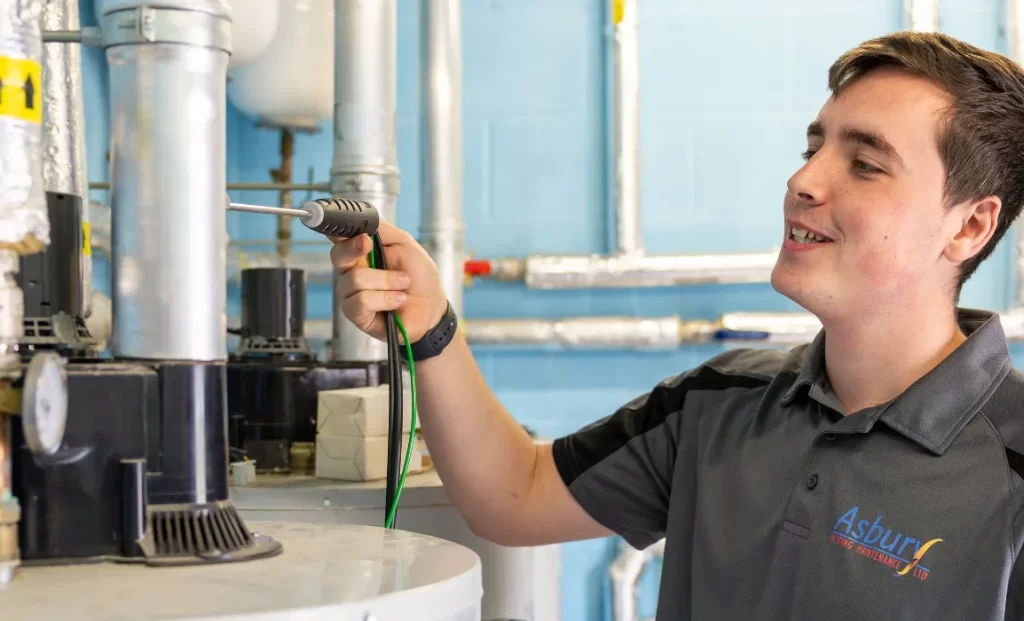
Every engineer on our team holds commercial Gas Safe registration, not just domestic. That distinction matters when the plant room in your leisure centre runs a 500kW commercial boiler that most domestic engineers have never worked on.
Our accreditations cover the full scope of work across a council estate:
- We hold commercial Gas Safe registration for gas-fired plant of all types and sizes.
- We are OFTEC registered for oil-fired systems at off-grid or rural council sites.
- We hold SafeContractor accreditation, which independently verifies our health and safety practices and ethical standards. This is increasingly a procurement requirement for public sector contracts.
- We provide 24/7 emergency callout with engineers on site within 2 to 4 hours for registered contract clients.
- A single contract covers your entire estate, with a single point of contact and consistent documentation across every building.
Council Buildings We Work Across
One Contractor Across Every Building Type
Council estates rarely follow a pattern. A leisure centre may need attention at 6am before the first session. A library heating fault needs to be resolved before opening. A community hall sits dark for a week, then needs reliable warmth for a Friday evening event. We schedule planned maintenance around your building’s use, and not the other way around. Our engineers work across your full estate without needing a different contractor for each building type.
Our Council Heating Process
From the first survey through to an active maintenance contract, here is how we work:

Know exactly where your estate stands before any work begins. Our Gas Safe engineers visit every building, assess the plant, and identify compliance gaps against the Gas Safety Regulations 1998 and L8 (ACoP). This way, the contract you sign reflects what your estate actually needs.

A maintenance schedule built around how your buildings run, not how it suits us. Work is planned around occupancy patterns and council procurement requirements, with a clear scope and transparent pricing agreed before anyone picks up a tool.
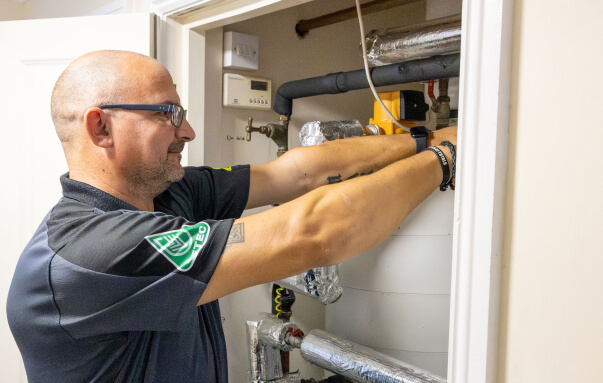
Every boiler on your estate is serviced, documented, and compliant after every visit. Our Gas Safe engineers carry out installations and planned preventive maintenance across gas, LPG, and oil-fired systems, with written records provided after each visit that satisfy your audit trail requirements.

Your gas infrastructure is tested to the standards insurers and the Health and Safety Executive (HSE) expect. We hold CMDDA1 and CMDDA1S certifications and provide full compliance documentation upon completion, including written records that meet insurance requirements.

The difference between a fault logged and a fault fixed is direct contact with no call centre. Registered contract clients can reach our team at any time. We guarantee an engineer on site within 2 to 4 hours, so a fault at 3am in a leisure centre does not become a closure at 7am.
Commercial Heating Systems for Council Buildings
No two council buildings share the same heating requirement. The system that works in a civic office is not the right specification for a leisure centre or an off-grid community hall.
The right system depends on your building type, fuel supply, and usage pattern:
Gas-Fired Commercial Boilers
The reliable workhorse for every council building on mains gas. Gas-fired commercial boilers suit offices, libraries, and town halls with consistent occupancy and a mains gas supply. Our engineers are qualified on the larger, more complex plant your estate actually has, not the domestic kit.
Liquefied Petroleum Gas (LPG) Systems
Off-grid doesn’t mean off-standard. LPG systems keep community buildings, rural facilities, and sites without mains gas running to the same compliance and performance standard as any mains-connected site on your estate.
Oil-Fired Boilers
Rural council sites and depots are covered. OFTEC-registered engineers install and maintain oil-fired boilers at rural council properties, depots, and military-adjacent sites. Expect the same documentation and compliance record as every other building in your contract.
High-Output Hot Water Systems
Leisure centres and changing rooms require a boiler specification that matches their hot-water load. Commercial boilers for high-demand facilities are sized and configured differently from those serving offices or libraries, and an undersized system will show the gap within the first season of use.
Pressurisation & Expansion Equipment
Keep your heating system at the right pressure, and you avoid the cascade of faults that follow when it drops. Pressurisation units and expansion vessels are part of the plant specification for any sizeable council building, and planned maintenance on this equipment is what prevents unexplained pressure loss from becoming a boiler shutdown.
What Does a Council Heating Contract Cost?
The short answer is that reactive heating management costs more. Emergency callout rates exceed planned service rates. Parts sourced at short notice carry a premium. A building that closes due to a heating failure incurs service continuity and reputational costs that are not reflected on the repair invoice. A structured maintenance contract can reduce operational costs by up to 30% compared to reactive fault management.
Contract pricing for a council estate depends on the number of buildings covered, the types of plant installed across the estate, the fuel types in use, and the required inspection and service frequency. We structure contracts to meet council procurement standards. You can expect a defined scope, set written response time commitments, and transparent pricing from the outset, with no variable rates for out-of-hours attendance.


Areas We Cover
We provide council heating services across the south of England, with engineers operating locally across:
- Dorset, including Bournemouth, Poole, Dorchester, and Weymouth.
- Hampshire, including Southampton, Winchester, Portsmouth, and Basingstoke.
- Wiltshire, including Salisbury, Swindon, and Chippenham.
We also cover East and West Sussex, Surrey, and parts of Devon. Working locally keeps travel distances short and response times fast. Our clients agree that this is a practical advantage when your contract specifies a 2- to 4-hour emergency attendance window.
Stop Managing Your Estate's Heating Reactively
Reactive heating management creates unpredictable costs, incomplete compliance records, and a repair log that grows faster than your maintenance budget can keep up. A structured contract replaces that with scheduled inspections, documented compliance, and guaranteed emergency cover in the event of an unplanned fault.
Asbury Heating has provided commercial heating and boiler services to local authorities and public sector clients across the South of England since 1962. Our Gas Safe-registered engineers work across council estates of all sizes, with contracts designed to meet public sector procurement requirements and keep every building on your estate running throughout the year.
To discuss a maintenance contract for your council estate, call 01202 745189 or complete the enquiry form.
Frequently Asked Questions
Yes, under the Gas Safety (Installation and Use) Regulations 1998, any entity responsible for a gas appliance in a non-domestic building has a legal duty to ensure it is maintained in a safe condition. For councils, this applies to every building that uses gas. The obligation extends to keeping records of inspections, as a repair log alone does not satisfy the requirement. Commercial heating legal obligations for UK employers cover what the regulations require and what constitutes adequate documentation.
For council and public sector contracts, the minimum requirements are:
- Commercial Gas Safe registration covering the appliance types on your estate.
- OFTEC registration for any oil-fired systems at off-grid or rural sites.
- SafeContractor accreditation, which independently verifies health, safety, and ethical standards.
- CMDDA1 and CMDDA1S certification for gas-tightness testing and purging work.
SafeContractor accreditation is increasingly a formal procurement requirement for public sector contracts. Asbury holds all four, and full details are on our commercial gas testing and purging page.
Three things matter above anything else for a public sector estate:
- Commercial Gas Safe registration for every engineer attending the site, not just the company at the entity level.
- A written emergency response commitment with a guaranteed attendance time, not a best-endeavours clause.
- Ensure documented service records are produced after every visit. A reactive repair model dressed up as a contract does not satisfy compliance requirements.
A contractor who cannot demonstrate all three is not suitable for a council estate. What to look for in a contract heating company sets out the full assessment framework.
There is no single regulatory threshold, but commercial boilers typically start at around 70kW. The distinction matters because commercial plant requires commercially registered Gas Safe engineers, not domestic-registered ones, to install and service them. A large boiler in a leisure centre plant room is a different proposition from a domestic appliance, and commercial boiler servicing must be carried out by engineers qualified on that class of appliance.
Commercial boilers are designed for higher output, continuous or near-continuous operation, and more complex system configurations, such as cascade arrangements, pressurised circuits, buffer vessels, and building management system integration. They are also subject to different regulatory requirements. A domestic Gas Safe registration does not cover commercial appliances, which is why the distinction between domestic and commercial Gas Safe registration matters when a council is procuring a contractor.
Commercial boilers are categorised by fuel type and heat exchanger design. Across a council estate, the main fuel types are natural gas, LPG, and oil.
By configuration, the most common are:
- Fire-tube boilers, where hot gases pass through tubes surrounded by water.
- Water-tube boilers, where water passes through tubes surrounded by hot gases.
- Condensing boilers, which recover heat from flue gases to improve efficiency.
Most modern commercial installations use condensing technology regardless of fuel type. Understanding commercial boiler system layouts covers how these configurations apply across different building types.
At a minimum, annually, but the correct interval depends on the appliance, its usage intensity, and the manufacturer’s specification. High-demand sites such as leisure centres or buildings with continuous hot-water loads may require more frequent inspections. Whatever the schedule, each service visit should produce written documentation forming part of your compliance record. A commercial maintenance contract sets that schedule, documents every visit, and provides 24/7 emergency cover between services.
A well-maintained commercial boiler typically lasts between 15 and 25 years, though this varies by manufacturer, usage intensity, water quality, and service history. Boilers running on reactive maintenance alone tend to reach the lower end of that range. For a council with capital planning responsibilities, planned servicing extends operational life and produces the records that support any warranty or insurance claim. How often a commercial boiler should be replaced is determined by indicators that point toward replacement rather than continued repair.
Summer is the practical answer for most council buildings. Heating demand is at its lowest, plant rooms are accessible without disrupting occupied spaces, and engineer availability is better than in the autumn run-up to winter. Planning a replacement during summer also avoids the scenario where a deteriorating boiler limps toward failure mid-season, when the consequences for building users are considerably worse. Why summer is the best time for a commercial boiler service sets out the operational and cost case.
It depends on installation complexity. A straightforward like-for-like replacement on a prepared site can be completed in two to three days. A full plant room replacement, including new pipework, controls, and commissioning, can take several weeks. The variable most often underestimated is the equipment procurement lead time. For a council estate, planning the replacement in advance rather than responding to a failure is what keeps buildings operational. Commercial boiler installations follow a surveyed process from specification through to compliance handover.