The Commercial Landlord’s Guide to Gas Safety Compliance
An annual gas safety check missed by a few weeks rarely looks serious at the time. No one chases it, no one flags it, and the paperwork gap sits quietly until something forces it into the open. By then, the options have narrowed. A claim follows an emergency incident, and the insurer asks for a current certificate that does not exist. An inspector requests records that were never properly kept.
Commercial landlord gas safety compliance is not the same as the domestic version most letting guidance describes. Unfortunately, landlords who assume otherwise often discover the difference at the worst possible moment, with different certificates, different engineer qualifications, and different consequences riding on the gap.
This guide sets out the legal duties, the certificate requirements, and what happens if compliance falls short.
What Are a Commercial Landlord's Legal Duties for Gas Safety
A commercial landlord must arrange an annual gas safety check on every gas appliance and flue provided for use on the let premises, keeping that check current for as long as the appliance remains in use. Where a property is sublet, the original landlord keeps this duty.
The check must be done every year without exception, and a new appliance must have its first check within 12 months of installation.
The rules that govern this include the following:
The original landlord cannot pass the duty to a subletting tenant.
A check can be brought forward by up to two months without losing the original anniversary date.
Appliances serving non-residential areas only may sit outside this specific duty.
What does not flex is the underlying duty itself. If an appliance serves only a non-residential part of a building, such as a standalone fire in a pub’s bar area, duties under the Health and Safety at Work Act and other workplace legislation will usually apply instead.
What a Valid Commercial Gas Safety Certificate Looks Like
A landlord’s gas safety record, still commonly called a CP12 because of its original form number, must contain specific information regardless of who designs the paperwork. A certificate missing any of the required elements is not doing its job, whatever it is labelled.
As a minimum, a valid certificate must include the following:
A description and location of each appliance or flue checked.
The engineer’s name, registration number, and signature.
The date of the check and the property address.
The landlord’s name and address.
Any defect found and the remedial action taken.
CP42 is the equivalent reference some engineers use for non-domestic and mixed-use commercial premises, reflecting the slightly different scope of checks on larger appliances. Whichever label is used, the engineer who signs it off must be registered with Gas Safe specifically for commercial work, not just domestic systems.
Records can be kept electronically, provided they can be reproduced in hard copy on request and uniquely identify the engineer. Landlords must give tenants a copy of the check within 28 days of it taking place, and provide a current copy to any new tenant before they move in. The record functions as a living document, updated with follow-up action once a defect has been remedied.
What Happens if A Commercial Landlord Falls Short on Compliance
A missed or invalid gas safety check is a breach of the Gas Safety (Installation and Use) Regulations 1998, which cover domestic and commercial premises, including offices, shops, and public buildings. That breach carries real enforcement exposure from the Health and Safety Executive (HSE), in addition to the more immediate risk to anyone using the premises.
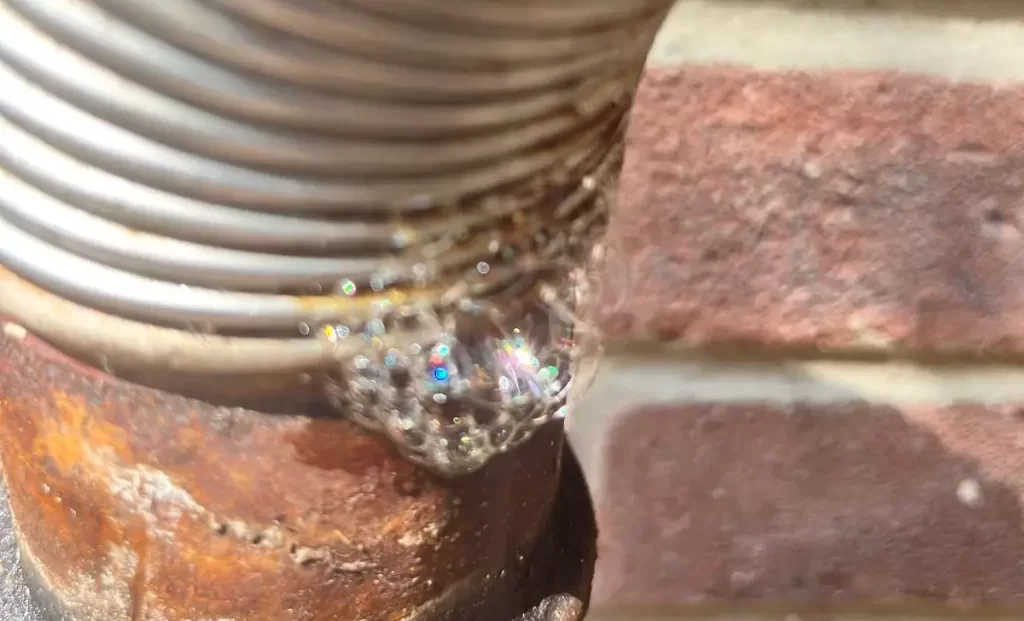
Where defects are identified, landlords are expected to act on them promptly, and any appliance suspected of being unsafe should be taken out of use until it has been put right. A gas leak at a commercial premises in West Parley, investigated and resolved by our team, shows how quickly a seemingly routine issue can escalate when gas is involved.
The fallout from a lapsed check rarely waits for a formal enforcement letter. A current, valid certificate is often the first document an insurer asks for after an incident, and its absence can affect what the policy actually pays out. None of this requires a dramatic failure. It usually starts with an annual check that slipped by a few weeks and was never properly tracked.
Get Ahead of Your Gas Safety Obligations
Most commercial landlords find out about a gap in their compliance at the worst possible time, mid-claim or mid-inspection, when there is no longer room to fix it quietly. Knowing the legal duties, the certificate requirements, and the consequences of a lapsed check closes that gap before it opens.
Asbury Heating has worked across commercial gas safety and compliance testing for over 60 years, with engineers registered with Gas Safe specifically for commercial work, not just domestic appliances. That commercial registration sits alongside SafeContractor accreditation, backed by a gas-tightness testing and purging service built for exactly this kind of compliance gap.
Call 01202 745189 or arrange a site survey through our contact page to book your free commercial gas safety audit and find out where your property stands.
[3] GOV.UK, Health and Safety Executive (HSE), Industries, Gas, Domestic Gas, Landlords’ Responsibility for Gas Safety, Gas Safety Check Records and What To Keep: https://www.hse.gov.uk/gas/landlords/gassaferecord.htm
[4] GOV.UK, Health and Safety Executive (HSE), Publications, Full Catalogue, Legal Reference (L), Gas Safety (Installation and Use) Regulations 1998 (GSIUR) As Amended. Approved Code of Practice and Guidance (2018): https://www.hse.gov.uk/pubns/books/l56.htm
Gas safety, workplace temperature duties and boiler servicing records all form part of commercial heating legal requirements that UK employers must meet.
According to Gas Safe-registered engineers, commercial boiler installation times range from 2 days for a single replacement to 8 weeks for a plant room.
Boiler efficiency metrics show how much fuel becomes useful heat in a commercial building and how AFUE and thermal efficiency compare boiler performance.
Boilers with renewable energy integration combine a boiler with renewable heat sources to reduce fuel use and share heating demand in commercial buildings.
High capacity boilers improve heating in large buildings by delivering consistent output, strong flow rates and reliable performance across multiple zones.